Users & Accounts
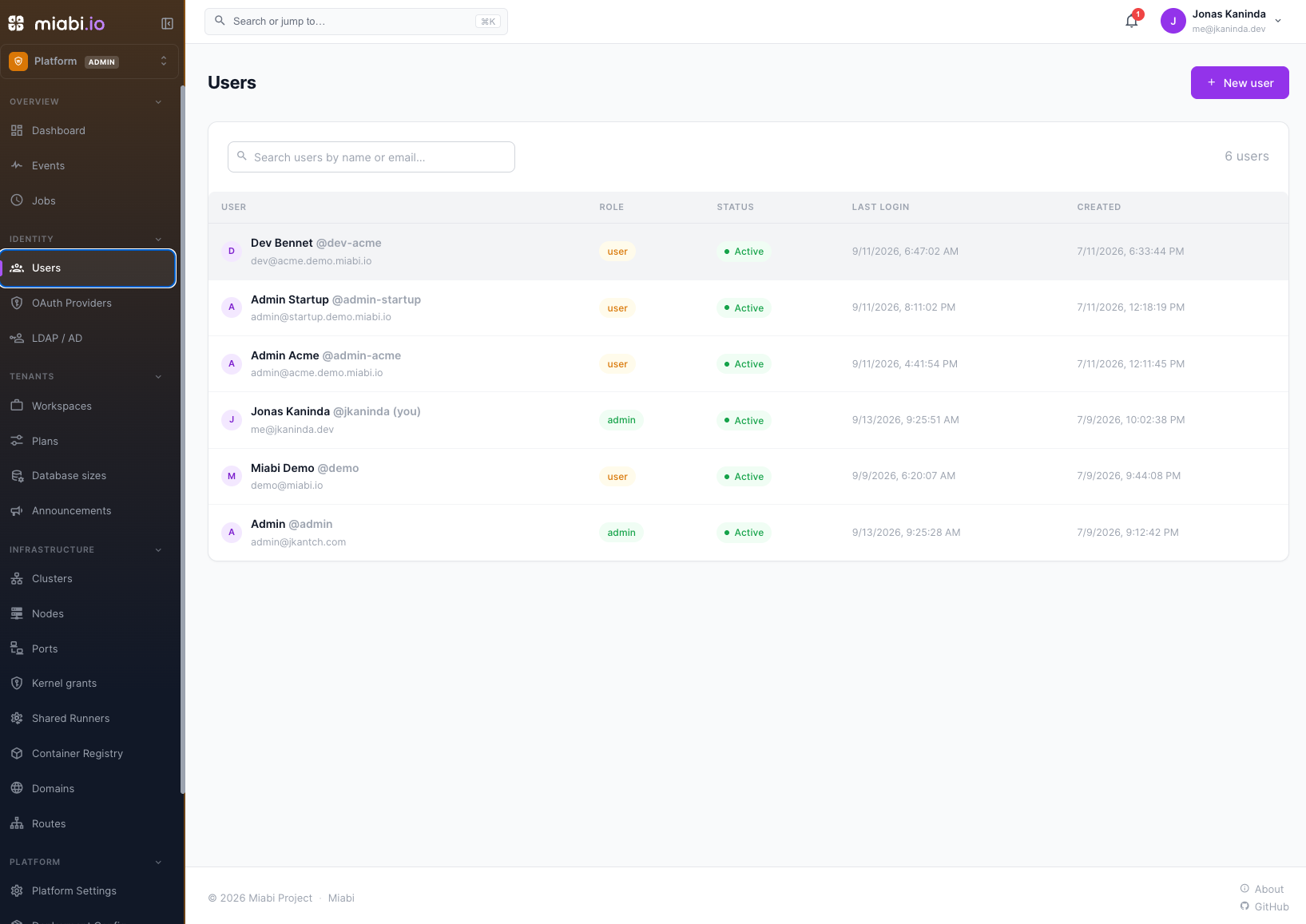
Accounts are platform-level: a user exists on the instance, then joins workspaces. This page covers what a platform admin can do to an account. Everything here lives under Platform admin → Users.
Registration is closed by default
Out of the box there is no public sign-up. The platform admin is seeded at install, and every other account is created by an admin or arrives through SSO / a directory. A self-hosted PaaS with open registration is an open door to your Docker host, so an upgrade never opens it for you.
Opening self-service sign-up
Sign-up is switched on by the environment, not from the console: opening it lets a stranger create an account, so it takes control of the deployment rather than an admin session.
| Variable | Default | Purpose |
|---|---|---|
MIABI_REGISTRATION_ENABLED | false | Shows Sign up on the sign-in page and accepts new accounts. Read at boot only. |
MIABI_REQUIRE_EMAIL_VERIFICATION | (unset) | true makes a new account verify its address before it can sign in |
MIABI_ALLOWED_SIGNUP_DOMAINS | (unset) | Comma-separated allow-list, e.g. acme.com,acme.co.uk. Subdomains match their parent. |
The last two are ordinary platform settings (require_email_verification,
allowed_signup_domains) you can also edit in Platform Settings. Setting the variable pins the
setting and re-applies it on every boot.
- Verification needs mail. If verification is required but no mail server is configured, sign-up stays closed: the accounts it created could neither sign in nor verify themselves.
- The allow-list is not revealed. An address from a domain that is not allowed gets the same answer as a successful sign-up, so nobody can probe it for your organisation's domains.
- A self-chosen password must be at least 12 characters.
A new account is an ordinary user, never a platform admin. Every sign-up is written to the audit log. For the sign-up and verification flow a user sees, see Authentication.
Creating an account
Users → New user. You set the name, email, username and initial password, and choose whether the account is a platform admin.
An admin-set password is marked must change: the user is sent to a change-password screen at first sign-in and cannot reach the console until they set their own. You never need to learn the password they end up with.
Account actions
Open a user to reach the actions below.
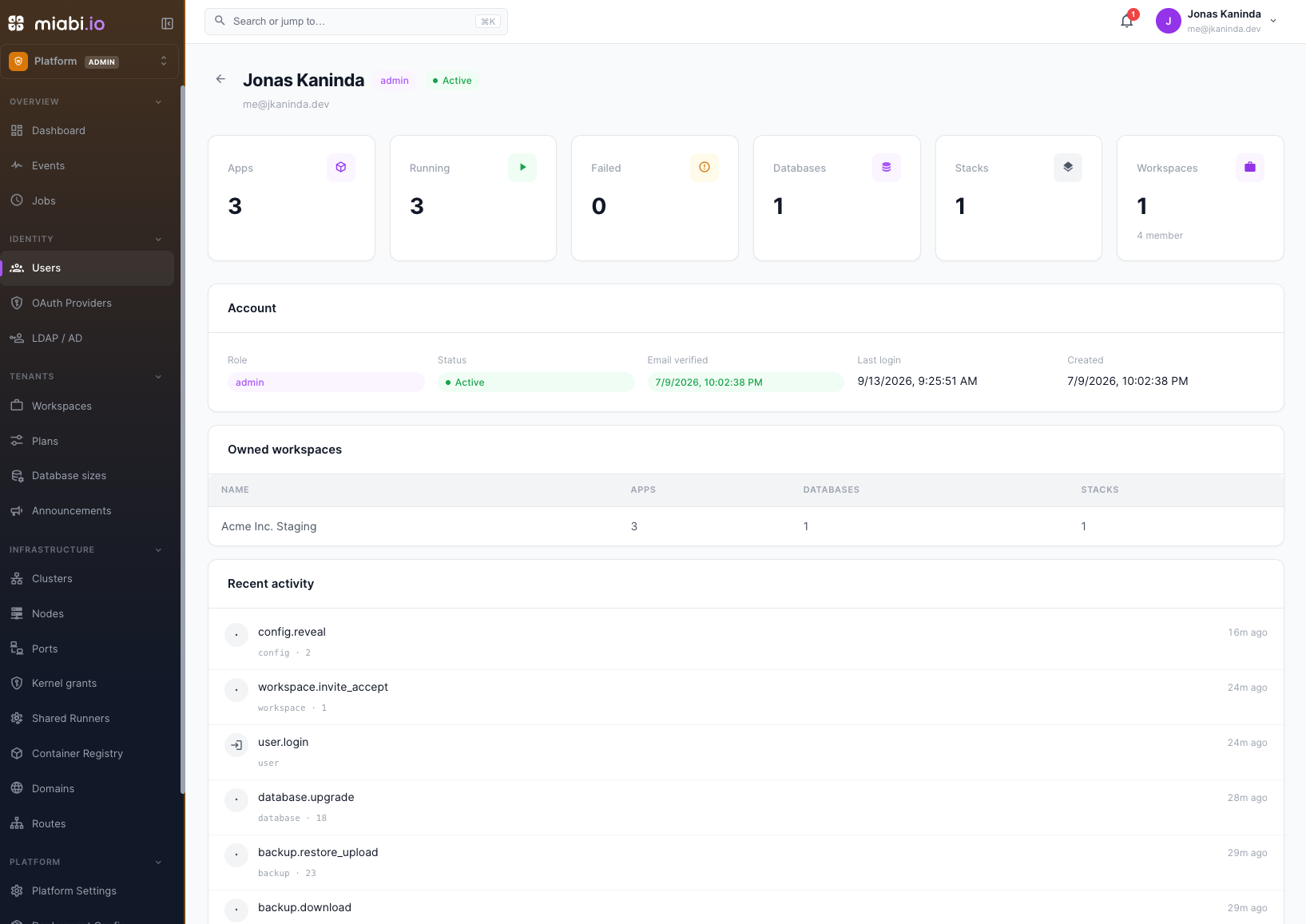
| Action | What it does | When you need it |
|---|---|---|
| Reset password | Issues a new temporary password with the must-change flag set | The user is locked out and self-service reset is disabled or their mail is broken |
| Verify email | Marks the address verified without the user clicking a link | Their mail never arrived, and you have confirmed the address another way |
| Revoke sessions | Signs the account out everywhere immediately | A laptop was lost, or you suspect a stolen session |
| Disable two-factor | Clears the TOTP secret so the user can enrol again | They lost their authenticator and their recovery codes |
| Deactivate | Blocks sign-in and stops the workspaces they own | Offboarding, or an account under investigation |
Disable two-factor removes a security control on someone else's account. Confirm the request out of band — a support ticket asking to disable MFA is exactly what an attacker sends. Every one of these actions is written to the audit log.
Per-user limits
Two limits can be overridden per account, on top of the platform-wide defaults:
| Limit | Meaning |
|---|---|
| Workspaces owned | How many workspaces this user may create and own |
| Workspace memberships | How many workspaces they may belong to as a non-owner |
Leave both unset to inherit the platform defaults, the
platform settings max_workspaces_per_user and
max_workspace_memberships_per_user (both 3; 0 for memberships means unlimited). Per-user
overrides are an Enterprise capability; the
platform-wide limits are always available.
Deleting an account
Deletion is scheduled, not immediate. It runs after a grace period
(MIABI_DELETION_GRACE_DAYS, default 7), and until then it can be cancelled.
| Step | Effect |
|---|---|
| Deactivate first | Scheduling is refused for an active account, so disable it first — that is what stops its workloads |
| Schedule deletion | Optionally hands some of its owned workspaces to another member first, then sets a deletion date and signs the account out everywhere |
| Cancel deletion | Clears the deletion date. The account stays deactivated until you re-activate it |
| Force deletion | For an account already pending deletion: skips the rest of the grace period and tears down now |
A workspace you transfer gets its new owner — who must already be a member — and survives. You cannot schedule or force the deletion of your own account.
When the deletion runs (the daily account-purge job, or a force deletion), the workspaces the user still owns are torn down with them — apps,
databases, volumes and their data. Workspaces where they were only a member are untouched,
they simply lose the membership.
Force deletion destroys data immediately and cannot be undone. Take a workspace export of anything you might need first. The grace period exists precisely because this decision is often reversed within a day.
The last admin is protected
Miabi refuses to remove platform-admin rights from, deactivate, or delete the last platform admin. There is no supported path to an instance nobody can administer.
Where to go next
- Roles & Permissions — what a user can do inside a workspace, which is a separate layer.
- Authentication and SSO — how accounts sign in.
- Audit log — the record of every action on this page.